The Ödrift project is about installing, testing and demonstrating how a centrally located battery storage can enable electricity supply to critical societal activities.
In the event of a long-term power outage, the energy storage will provide short-term supply for, for example, the rescue service, the sports hall and the municipality's IT unit, and not least, it will ensure the start-up of the Ludvika power station, which in turn can then supply the above-mentioned and other properties in Ludvika with electricity. Today, the properties have traditional backup with diesel generators.
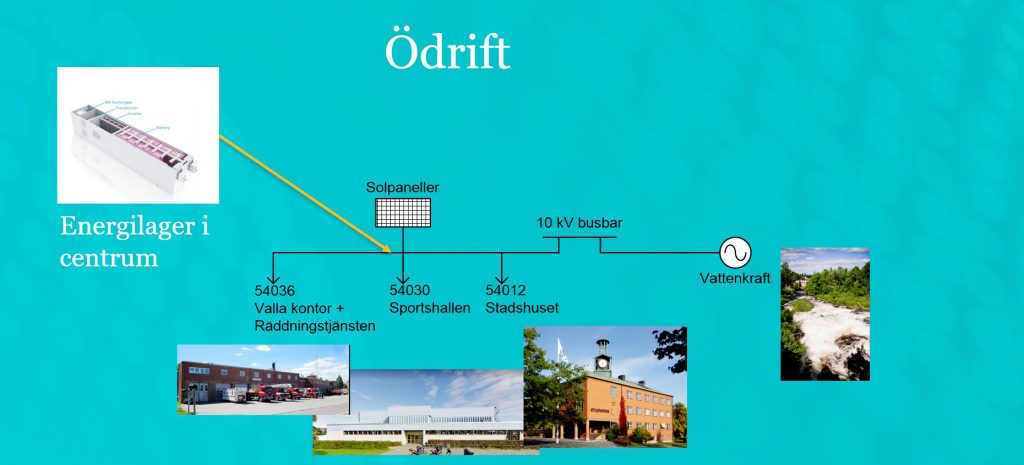
The first thing that happens after a decision to switch to island operation is that Ludvika is isolated from the main grid and all loads are disconnected. Then, some properties are connected to the battery storage system, which is tasked with creating a sine voltage (grid forming mode) and maintaining voltage and frequency. The hydropower plant in central Ludvika is prepared for start-up and receives its auxiliary power from the battery storage. The power plant is started up in island operation mode with a small power boost. The protection settings in the island operation network are adjusted to prevent unnecessary protection interventions.
Voltage and frequency
During the development of the project, stability studies have been carried out showing that the system maintains voltage and frequency when connecting and disconnecting the loads that are part of the small grid. From a previous study regarding island operation in Ludvika [1] it is clear that the frequency may only vary within the range of 49.0 – 51.0 Hz and that the voltage at the consumer may only vary by a maximum of ± 10%. For all studied cases, the voltage is clearly within the applicable limits (± 10%).
The largest voltage changes occur in connection with the connection and disconnection of the load for the power station's auxiliary power system. The highest voltage is 406 V and the lowest voltage is 386 V. The frequency variations are also the largest when the load for the power station's auxiliary power system is connected and disconnected. With the standard settings in the energy storage control system, the frequency temporarily drops below the limit (49 Hz) when the load for the rescue service is connected and permanently below the limit when the power station's auxiliary power system is connected. If the control system's Frequency Droop is adjusted, the frequency variations in the network become acceptable. After the load for the rescue service is connected, the frequency is approx. 49.8 Hz and after the load for the power station's auxiliary power system is connected, 49.7 Hz.
The total load on the energy storage is in all cases within the storage capacity (90 kVA), both short-term and long-term.
Hydropower and battery in interaction
The hydroelectric power plant has an installed capacity of 3.5 MW and is therefore significantly stronger than the battery storage system. When both are connected, the hydroelectric power plant will be the master and maintain the frequency. The battery storage system will then switch to another operating mode and compensate for voltage and frequency variations. Finally, other socially critical properties will be connected according to a predetermined priority order.
The battery storage system has an automatic charging function adapted to the conditions that apply in this particular system.
The energy storage will thus be a central part of a local microgrid. It will also function as a test facility for active control of energy use.
In collaboration with Luleå University and Dalarna University, a doctoral thesis will be carried out based on energy storage and island operation.